Water damage in Austin is not the same as water damage in Phoenix or Pittsburgh. The geology here — specifically the expansive black clay that dominates soils east of I-35, and the thin limestone runoff terrains of the Hill Country to the west — means that a single hard rain does things to a Central Texas home that a homeowner in a drier or more permeable landscape simply would not deal with. Buda and the broader Austin metro sit right on the Balcones Escarpment, the geological line that makes this region the most flash-flood-prone corridor in the United States. Understanding that context is the starting point for understanding what water damage restoration actually involves around here.
This guide is for homeowners who want to understand the process — what is happening to their house at each stage, what decisions they genuinely control, what they can handle themselves, and when professional help is not optional.
Why Central Texas Water Events Are Different
The Balcones Escarpment runs from Waco south to Uvalde, roughly following I-35. The Edwards Plateau to the west is almost pure limestone — nearly impermeable. When rain falls on the Hill Country, water moves fast. It does not soak in; it runs off into creeks and rivers that can rise feet per hour. Austin's Highland Lakes and the low-water crossings throughout Hays and Travis counties reflect this reality. Flash floods represent 98 percent of all flood events in the Austin area, according to the City of Austin's Watershed Protection Department.
The soil east of I-35 — the Taylor Black Clay that covers much of Buda and South Austin — behaves like a sponge that never properly drains. During a drought it contracts and shrinks away from your foundation, opening gaps. When heavy rain follows, the soil expands rapidly against those same foundation walls, pushing moisture through hairline cracks in the slab. Homeowners sometimes discover interior water intrusion hours after the rain stops, not during it. That delayed onset confuses people who assume dry weather means they are in the clear.
The result is that Austin-area homeowners face two distinct water damage mechanisms: the fast, visible flooding from storms and the slow, invisible intrusion tied to soil movement and pressure. Both require attention, but they present differently and are handled differently.
The First 48 Hours — What Is Actually Happening
The EPA advises drying water-damaged materials within 24 to 48 hours to prevent mold growth. That figure is not arbitrary. Under the temperature and humidity conditions typical of a Central Texas home — especially in summer — mold spores that land on wet drywall, insulation, or wood framing can begin germinating within that window. Central Texas heat accelerates this: a house in August with a compromised HVAC system can spike into the 80s or 90s indoors, conditions that are nearly ideal for fungal growth.
During those first 48 hours, several things are happening simultaneously inside your walls that you cannot see. Paper-faced drywall begins absorbing moisture within minutes of contact. The paper facing is a food source for mold; the gypsum core weakens structurally. Insulation — particularly fiberglass batt, which is what most Austin-area homes built before 2010 use — holds water like a wick and dries extremely slowly without mechanical assistance. Wood framing, if exposed, begins to swell and can cup, warp, or crack.
What you can do yourself in the first hour: turn off electricity to any affected area at the breaker before entering, stop the water source if it is an internal failure (a burst supply line, an overflowing appliance), and document everything with photographs and video before moving anything. That documentation is the foundation of your insurance claim — carriers will want to see the condition at discovery, not after you have already cleaned up.
Water Categories: This Matters for What Comes Next
Restoration professionals classify water into three categories, and the category determines how aggressively the cleanup must be handled.
Category 1 is clean water — from a supply line break, a rain intrusion through a window, or an overflowing sink. This is the most straightforward to remediate, and a capable homeowner with a wet/dry vacuum and rental dehumidifiers can manage small-area Category 1 events without professional help. A bathroom supply line that sprayed for a few hours and soaked one section of subfloor is a reasonable DIY job if you act quickly and monitor moisture levels.
Category 2 is gray water — discharge water from washing machines, dishwashers, or HVAC condensate drains. It contains biological or chemical contaminants that make it unsafe to handle without protective equipment. Surfaces that have been in contact with gray water need to be disinfected, not just dried.
Category 3 is black water — sewage, floodwater from outside your home, or any water that has been standing long enough to grow bacteria. A Blanco River overflow, a storm surge through a door, or a backed-up sewer line all fall into Category 3. This is not a DIY situation. Category 3 events require full personal protective equipment, specialized biocide treatment, and in many cases removal of materials that cannot be adequately cleaned — including drywall below the flood line and all wet carpet and pad.
The Extraction and Drying Process
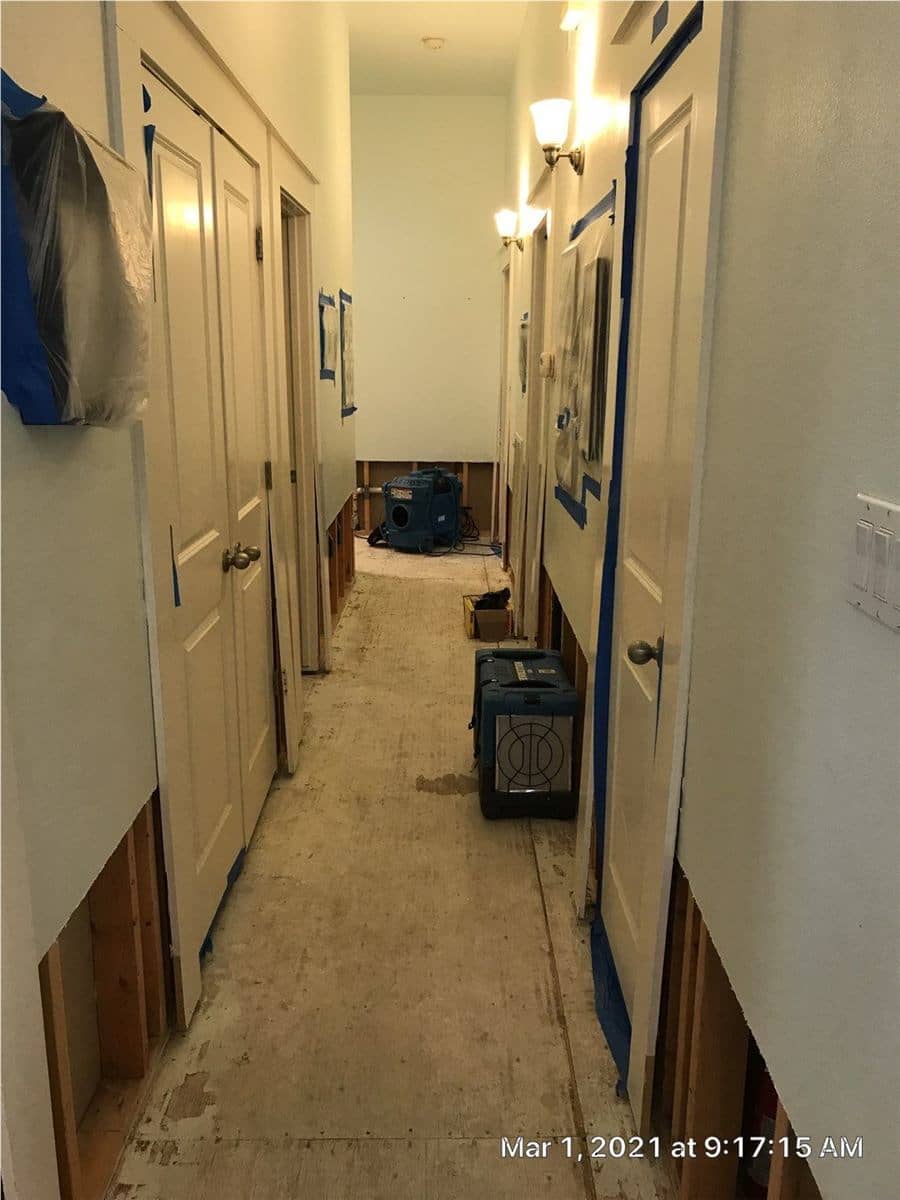
Removing standing water is only the first step. The work that follows — structural drying — is what most homeowners underestimate. Industrial air movers and commercial dehumidifiers run at dramatically higher capacity than anything you can rent at a hardware store. A restoration-grade dehumidifier removes 150 to 200 pints of water per day from the air; a consumer unit might manage 50 to 70 pints under ideal conditions and less in a saturated space.
In a typical Austin home with slab-on-grade construction — which describes the vast majority of houses built here since the 1970s — moisture can migrate under the slab and reappear elsewhere. A professional restoration team uses moisture meters and thermal imaging cameras to map the actual extent of saturation, which is almost always larger than what is visible. A wet spot on the floor in one room can mean the subfloor cavity is saturated into an adjacent space.
Drying times vary significantly. A single-room Category 1 event with prompt extraction might dry in two to three days. A multi-room event with saturated framing and insulation can take a week or more under continuous mechanical drying. That timeline matters because most Texas homeowners want to start repairs — replacing drywall, reinstalling flooring — before the structure is genuinely dry. Doing so traps moisture and almost guarantees mold inside the wall cavity.
Mold: When Remediation Becomes a Licensed Requirement
Texas is one of the few states with a formal licensing regime for mold remediation work. Under Texas Occupations Code Chapter 1958 and the rules established by the Texas Department of Licensing and Regulation at 16 TAC Chapter 78, any mold remediation work affecting 25 or more contiguous square feet requires a licensed mold remediation contractor. Smaller patches in a confined area — a single bathroom tile grout line — can be handled by a homeowner. But the threshold is lower than most people assume: a single wet drywall panel that has grown surface mold can easily exceed 25 square feet.
If mold is present, remediation is not simply a cleaning step. It involves containing the affected area to prevent spore spread during removal, using HEPA filtration, and removing materials that cannot be decontaminated rather than treating them in place. A clearance test — air sampling done by a licensed mold assessment consultant — is the only objective way to confirm the remediation worked before you rebuild.
Navigating Your Insurance Claim
Most standard homeowner policies in Texas cover sudden and accidental water damage — a burst pipe, an appliance failure, rain intrusion through a storm-damaged roof. They do not cover gradual leaks or maintenance failures, and they generally do not cover flood damage from rising external water, which requires a separate NFIP flood policy.
If your damage is covered, a few things are worth knowing before you sign anything. Texas Insurance Code Section 707.002 requires that you pay your deductible — it is your legal obligation under the policy. Texas Business and Commerce Code Section 27.02 makes it a Class B misdemeanor for a contractor to waive, absorb, or rebate your deductible. If a restoration contractor offers to 'work with your deductible' or make it disappear, that is a red flag and potentially a criminal act carrying up to 180 days in jail and a $2,000 fine.
Document everything before remediation work begins. Your carrier will send an adjuster, and most major carriers now use their own estimating software. Having your own scope and documentation — including the moisture readings taken at intake — gives you a basis to push back if the adjuster's estimate is low.
Texas Civil Practice and Remedies Code Section 16.003 gives you two years from the date of the damage event to file suit on a property damage claim if a dispute arises. That is relevant if you and your carrier cannot reach agreement — you have time to work the process, but do not let the deadline slip quietly.
What You Can Do Yourself — Honestly
Small Category 1 events caught immediately are genuinely within the reach of a motivated homeowner. A supply line under a sink that dripped for an hour, a dishwasher that overflowed onto a tile floor with no adjacent drywall contact, a small roof leak caught at a bucket stage — these do not require professional intervention if you can verify the moisture readings drop to normal within 48 to 72 hours. A basic non-penetrating moisture meter costs under $30 and will tell you whether the adjacent materials are drying.
What is outside the DIY zone: any event involving Category 2 or 3 water, any saturation that has reached wall cavities or insulation, any event where you cannot verify dry conditions within 72 hours, and any situation where mold is already visible. In Central Texas, given the humidity and heat, the risk of a borderline DIY job turning into a $10,000 mold remediation is high enough that the honest calculus usually favors professional extraction and drying even when demolition is not yet warranted.
Preventing the Next Event
The most valuable thing you can do after a water event in the Austin area is audit why it happened and close that avenue. A few categories are worth prioritizing.
Supply line hoses on washing machines, dishwashers, and refrigerators degrade. The braided stainless variety lasts significantly longer than the rubber hoses that still come stock on many appliances. Replacing them is a 20-minute job and eliminates one of the most common interior flood sources.
Gutters and downspouts in a Central Texas clay-soil yard are more consequential than in other regions. If your downspouts terminate within a few feet of the foundation, every rain event is saturating and expanding the soil directly against your slab. Extending downspouts to discharge at least six feet from the foundation, and making sure the grade slopes away from the house, reduces both soil expansion pressure and the likelihood of moisture intrusion through the foundation.
If your home is in or near a FEMA-mapped flood zone — a meaningful percentage of Austin-area properties are — flood insurance is worth running the numbers on even if your lender does not require it. Standard homeowner policies exclude rising water from outside, and storm surge through a door is a Category 3 cleanup problem regardless of how the policy reads.
CDG Restoration & Construction is based in Buda and serves the Austin metro. If you are dealing with active water damage or want a professional assessment, call (737) 309-5075.
Related Reading
The Importance of Using a Skilled Water Restoration Company When Water Is Noticed in Your Home
When water shows up in your home, the clock is already running. Here is what a professional restoration company does that a shop vac and a few fans cannot, and why Central Texas conditions make the stakes higher.
Read moreHow to Choose a Restoration Contractor in Austin, TX
Water damage, fire, mold — when your Austin home is in crisis, the contractor you hire in the first few hours shapes everything that follows. Here is what to look for and what to avoid.
Read moreBest Practices for Removing Wall Water Stains
That yellow-brown ring on your wall is telling you something. Here is how to read it, clean it, and decide whether you are dealing with a surface fix or a deeper problem.
Read moreDealing With This Right Now?
Call and describe what you are looking at. We will tell you honestly what it is, whether it is worth an insurance claim, and what it takes to put right. Inspections and estimates are free.
Call Now