Water damage rarely announces itself loudly. More often, it shows up as a faint yellow ring on a ceiling, a floor board that suddenly feels soft underfoot, or a smell you can't quite place but can't ignore. By the time those signals become obvious, the moisture has usually been present long enough for mold to take hold. In Central Texas, where humidity climbs above 80 percent on summer mornings and flash flooding can push water into a slab-on-grade home with almost no warning, the window between a small leak and a serious remediation project can close faster than most homeowners expect.
Why Austin-Area Homes Are Especially Vulnerable
Austin receives an average of 34 inches of rainfall a year, and that rain tends to arrive in concentrated bursts rather than steady drizzle. The region sits in what meteorologists call Flash Flood Alley — Barton Creek, Onion Creek, Shoal Creek, and the Colorado River can all rise dramatically within hours. When that water reaches a foundation or floods a garage, the clock starts.
Slab foundations — which are standard in the Austin and Buda area from the 1970s through today — run copper or PEX supply lines directly through the concrete. The expansive clay soils across Hays County and Travis County swell when wet and shrink during the droughts that follow, and that seasonal movement stresses the plumbing constantly. A slow slab leak can go undetected for months, saturating the concrete below a finished floor before a single visible sign appears on the surface. Older pier-and-beam homes, common in some Buda and South Austin neighborhoods, have a different vulnerability: moisture accumulates in the crawl space, where there is no daily foot traffic to notice it, and wood rot progresses silently.
All of this matters because the EPA's guidance — backed by both CDC and OSHA research — is that mold can begin colonizing wet building materials within 24 to 48 hours under typical indoor conditions. In a Central Texas summer, when indoor temperatures rise and humidity is already high, that window may be even shorter.
Seven Signs Worth Taking Seriously
1. Stains and discoloration on ceilings or walls. Yellow, tan, or brown rings on a ceiling are almost always the outline of a dried water event. The stain marks the edge where water spread before it evaporated, and the center of the ring often tells you how many times the source wet and dried: each concentric ring is a separate episode. A single isolated stain might be a one-time roof penetration during a storm. Multiple overlapping rings, or a stain that has grown between your last two inspections, means the source is ongoing.
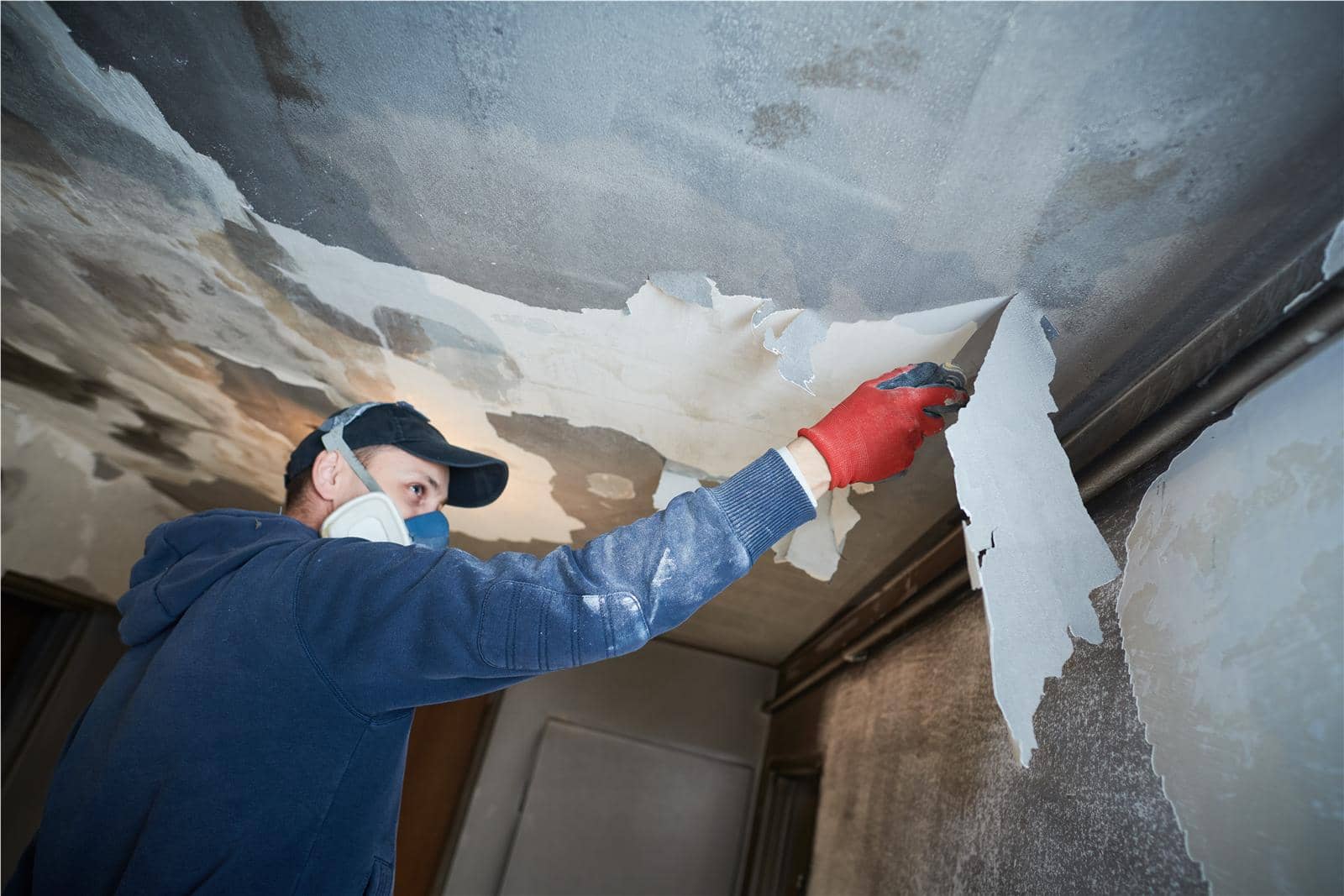
2. Peeling, bubbling, or flaking paint. Paint and drywall compound are vapor-permeable to a degree, but sustained moisture behind a wall defeats them. Bubbles form when water vapor pushes beneath the paint film. When the bubble breaks, you get flaking. This pattern on an exterior wall often points to a failed window seal, a gap in the caulk around a penetration, or a recurring splash-back problem from a roof valley that isn't draining properly.
3. A persistent musty or earthy odor. Mold produces microbial volatile organic compounds — MVOCs — as it metabolizes organic material. The smell is often described as earthy, musty, or like a damp basement, even in a house that has no basement. If you notice the odor most strongly in one room, or when the HVAC kicks on and distributes air from a particular zone, you have a clue about where to look. Do not assume air freshener or cleaning products solve it. The odor returns as long as the source remains.
4. Soft, spongy, warped, or buckled flooring. Wood absorbs moisture and swells. When it can't expand laterally because it's constrained by walls or adjacent boards, it buckles upward. With engineered wood or laminate, you'll often see gapping at the seams before the buckling becomes dramatic. With slab-on-grade homes in Buda and South Austin, soft spots in flooring that otherwise seems intact may indicate a slab leak saturating the concrete directly beneath the surface — the finish flooring is the first layer to fail. In pier-and-beam homes, a floor that springs underfoot or feels uneven can mean the subfloor or the joists themselves have absorbed prolonged moisture.
5. Damp or wet spots on walls, floors, or in cabinets. Under-sink cabinets are among the most common discovery points. The particleboard that makes up most cabinet bottoms swells and darkens well before a drip becomes a visible puddle. Base cabinets on exterior walls are another spot to check: the drywall behind the cabinet is exposed to the exterior sheathing, and if any flashing has failed, that wall section can hold moisture for a long time without ever showing a stain on the painted surface.
6. Visible mold growth. Mold is not always black. In its early stages it can appear white, gray, pink, or orange, depending on species and substrate. You may find it on grout lines in bathrooms or kitchens — that is the most common location — but also behind toilet tanks, along the base of exterior walls, or in the corner of a window frame where condensation collects. If you find what appears to be mold on a surface area of less than 25 contiguous square feet, Texas Occupations Code Chapter 1958 and the TDLR's rules under 16 TAC Chapter 78 do not require a licensed remediator for that work — the homeowner can address it. At or above 25 contiguous square feet, a licensed mold assessor must prepare a remediation plan and a licensed remediator must complete the work when you hire the job out — homeowners doing the work on their own residence are exempt — and a Certificate of Mold Remediation is issued at the close of the project. If you are a tenant, ask for a copy of that certificate before signing anything.
7. Worsening allergy symptoms or unexplained respiratory irritation. This is the sign that most homeowners dismiss the longest because it is easy to attribute to seasonal allergies, which in the Austin area are already severe. If symptoms improve when you leave the house and return when you're home, or if multiple people in the house are experiencing the same pattern at the same time, the indoor environment deserves a second look. Mold spores and MVOCs are known to aggravate asthma, trigger rhinitis, and cause eye and skin irritation, particularly in people who are immunocompromised or who have existing respiratory conditions.
What to Do When You Find a Sign
The severity of what you've found determines the response. A small stain on a ceiling after a documented one-time roof penetration — for example, a storm that blew off a few shingles — is different from a spreading discoloration with no obvious cause. Use these as rough decision points:
Stop the source first. No drying or remediation holds if water is still entering. Find the origin and stop it before anything else. For slab leaks, that means calling a licensed plumber to confirm the source; restoration work follows, not precedes, that repair.
Dry aggressively within the first 48 hours. If you catch water damage early, professional-grade air movers and dehumidifiers can dry wall cavities and subfloors without requiring demolition. The goal is to get structural moisture levels — measured with a calibrated pin or non-invasive moisture meter — back to acceptable levels before mold colonizes. Your restoration contractor should be documenting daily readings, not estimating by feel.
Do not simply paint over staining. Stain-blocking primer and fresh paint hide a water stain but do nothing about residual moisture in the drywall or framing behind it. If that material is still wet or if mold is already present, covering it traps the problem and makes it worse. The material needs to be confirmed dry and confirmed mold-free before any cosmetic repair.
Get the mold tested if you are uncertain what you are looking at. A licensed mold assessor — required to be licensed by TDLR in Texas — can take surface samples or air samples and tell you definitively what species is present and at what concentration. That matters for remediation scope and for your insurance documentation.
Photograph and document everything for your insurance claim. Texas does not cap the time to file a first-party property damage claim as tightly as some states — Texas Civil Practice and Remedies Code Section 16.003 gives a two-year limitations period for property damage claims generally — but your insurance policy will have its own prompt-reporting requirement. Read your declarations page now, before you have a claim, so you understand how quickly you are expected to notify your carrier.
When to Call a Restoration Contractor
Call immediately if water has been standing for more than a few hours, if the water source was a toilet overflow or any other potentially contaminated source (classified as Category 2 or Category 3 water under industry restoration standards), if the affected area includes insulation or wall cavities that cannot be dried from the surface alone, or if any structural framing is involved.
For slab-leak-related water damage in particular, the moisture profile under a finished floor can be substantial even when the visible damage looks minor. A moisture meter reading on the surface of a tile or hardwood floor will not tell you what the concrete slab below reads. The only way to know whether the slab has dried adequately is to measure it directly, usually by lifting flooring material or drilling a test hole.
CDG Restoration & Construction serves Buda, Austin, and communities across the Austin metro. The number is (737) 309-5075. If you are looking at something and are not sure whether it warrants a call, call anyway — a phone conversation costs nothing and can save you a significant amount in remediation costs if it redirects you toward early action.
A Word on DIY Versus Professional Remediation
Not every water damage or mold situation requires a contractor. A dripping supply line under a sink that you caught within a day or two, with no wall cavity involvement and a surface area of clean-up well under 25 square feet, is something most homeowners can handle: stop the leak, remove any wet particleboard or soft material, clean hard surfaces with a mold-inhibiting solution, dry thoroughly with fans, and confirm with a moisture meter before putting anything back. Texas law specifically exempts property owners who do the work on their own residence from the TDLR licensing requirement, regardless of project size.
Where it gets complicated — and where professional assessment genuinely pays off — is when the source is unknown, when moisture has spread beyond what is visible, or when the affected area involves wall cavities, insulation, HVAC ductwork, or structural framing. In those scenarios, the cost of professional moisture mapping and a documented dry-out is almost always lower than the cost of discovering months later that you encapsulated a mold colony behind new drywall.
Related Reading
Effective Strategies for Water Damage Restoration
Austin's geology makes water damage here different from anywhere else. Here is what actually happens to your home after a flood, and what to do about it in the first 48 hours.
Read moreThe Importance of Using a Skilled Water Restoration Company When Water Is Noticed in Your Home
When water shows up in your home, the clock is already running. Here is what a professional restoration company does that a shop vac and a few fans cannot, and why Central Texas conditions make the stakes higher.
Read moreHow to Choose a Restoration Contractor in Austin, TX
Water damage, fire, mold — when your Austin home is in crisis, the contractor you hire in the first few hours shapes everything that follows. Here is what to look for and what to avoid.
Read moreDealing With This Right Now?
Call and describe what you are looking at. We will tell you honestly what it is, whether it is worth an insurance claim, and what it takes to put right. Inspections and estimates are free.
Call Now